
Top Myths About EX4 to MQ4 Decompilers: Separating Fact from Fiction (2026 Guide)
Meta Title: Top Myths About EX4 to MQ4 Decompilers | Facts vs. Fiction (2026)
Meta Description: Discover the most common myths about EX4 to MQ4 decompilers, understand the limitations of compiled MetaTrader files, and learn best practices for protecting your trading software.
Top Myths About EX4 to MQ4 Decompilers
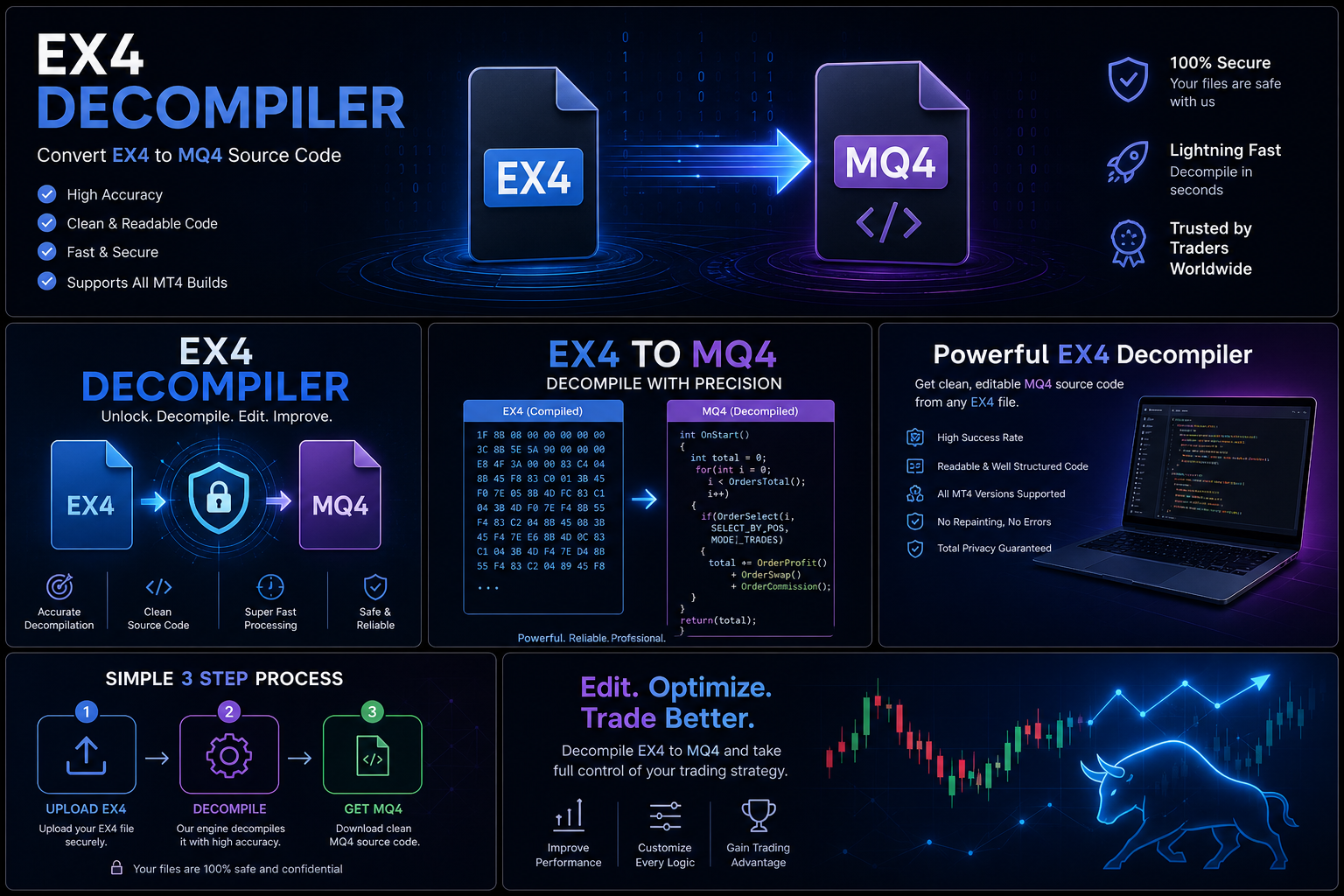
If you’ve spent time in MetaTrader forums or searched online for information about EX4 files, you’ve probably seen bold claims about EX4-to-MQ4 decompilers. Some websites advertise “100% recovery,” “perfect source restoration,” or “instant conversion” of any EX4 file into its original MQ4 source.
These claims can be confusing, especially for traders who have lost access to their own source code or are trying to understand how MetaTrader software works.
This guide examines some of the most common myths surrounding EX4-to-MQ4 decompilers, explains the technical realities at a high level, and offers practical advice for developers and traders.
Myth 1: Every EX4 File Can Be Converted Back into Its Original MQ4 Source
This is one of the most common misconceptions.
An EX4 file is the compiled form of an MQ4 project. During compilation, information that is useful during development—such as comments, formatting, and descriptive variable names—is generally not preserved in the executable.
As a result, an executable file should not be expected to contain a perfect copy of the original source code.
Myth 2: Recovery Always Produces the Original Project
Some people assume that any recovered source will be identical to the original.
In reality, even when meaningful information can be reconstructed in authorized recovery scenarios, the result may differ significantly from the original project structure. Development comments, formatting choices, and descriptive naming are often unavailable after compilation.
Myth 3: Every Online Tool Delivers the Same Results
Not all services or software advertised online are legitimate.
Some make unrealistic promises or exaggerate what is technically possible. Before relying on any provider, evaluate their reputation, communication, transparency, and willingness to explain the limitations of their service.
Myth 4: Decompilation Is Always Legal
Legality depends on ownership, licensing, contracts, and the laws that apply in your jurisdiction.
Recovering or modifying software without the appropriate rights may violate copyright or license agreements. If you need changes to software, it’s usually best to work with the original developer or ensure that you have explicit authorization.
Myth 5: There Is Never a Need for Backups
Some developers believe they can always recover lost work later.
In practice, maintaining multiple backups and using version control is far more reliable than depending on any form of recovery after a loss.
Good backup habits remain the best defense against losing valuable source code.
Myth 6: Older and Newer EX4 Files Behave the Same
MetaTrader has evolved over many years. Different platform builds and compiler versions have changed how applications are produced and executed.
Because of these changes, assumptions based on older software may not apply to newer projects.
Myth 7: The Cheapest Service Is Always the Best Choice
Price alone should not determine your decision.
When choosing professional assistance for software you own or are authorized to maintain, consider:
- Experience.
- Clear communication.
- Transparent expectations.
- Documented processes.
- Ongoing support.
- Honest discussion of limitations.
A trustworthy provider is more valuable than one making unrealistic guarantees.
What Should You Do If You Lose Your MQ4 Source?
If you’ve lost the original source code for software that you own or are authorized to maintain, consider these steps:
- Search all available backups and archived storage.
- Check cloud services and version control repositories.
- Contact the original developer if possible.
- Gather any project documentation or specifications.
- Consider rebuilding the application from authorized requirements if the original source cannot be located.
Planning ahead is usually more effective than relying on recovery after the fact.
Best Practices for Developers
To reduce the risk of losing valuable projects:
- Maintain multiple backups.
- Use version control.
- Archive stable releases.
- Keep project documentation up to date.
- Store copies in different physical locations.
- Review your backup strategy regularly.
These habits make long-term maintenance much easier.
Frequently Asked Questions
Can every EX4 file be restored perfectly?
No. Compiled executables generally do not retain all of the information present in the original source code.
Why are comments and formatting often missing?
These development details are typically not preserved during compilation.
Is recovering source code always appropriate?
Only if you have the legal right or authorization to do so. Copyright and license agreements should always be respected.
What’s the best way to protect an MQ4 project?
Use version control, maintain multiple backups, and store copies securely in separate locations.
Conclusion
The internet is full of claims about EX4-to-MQ4 decompilers, but many of them oversimplify a complex subject. Understanding the difference between executable files and source code, recognizing the limitations of compiled software, and respecting intellectual property rights will help you make more informed decisions.
If you’re developing MetaTrader applications, invest in strong backup practices and documentation. If you’re using commercial software, keep your license information, work with reputable developers, and communicate openly when you need updates or support. A realistic understanding of the technology is far more valuable than believing myths or promises that cannot be guaranteed.