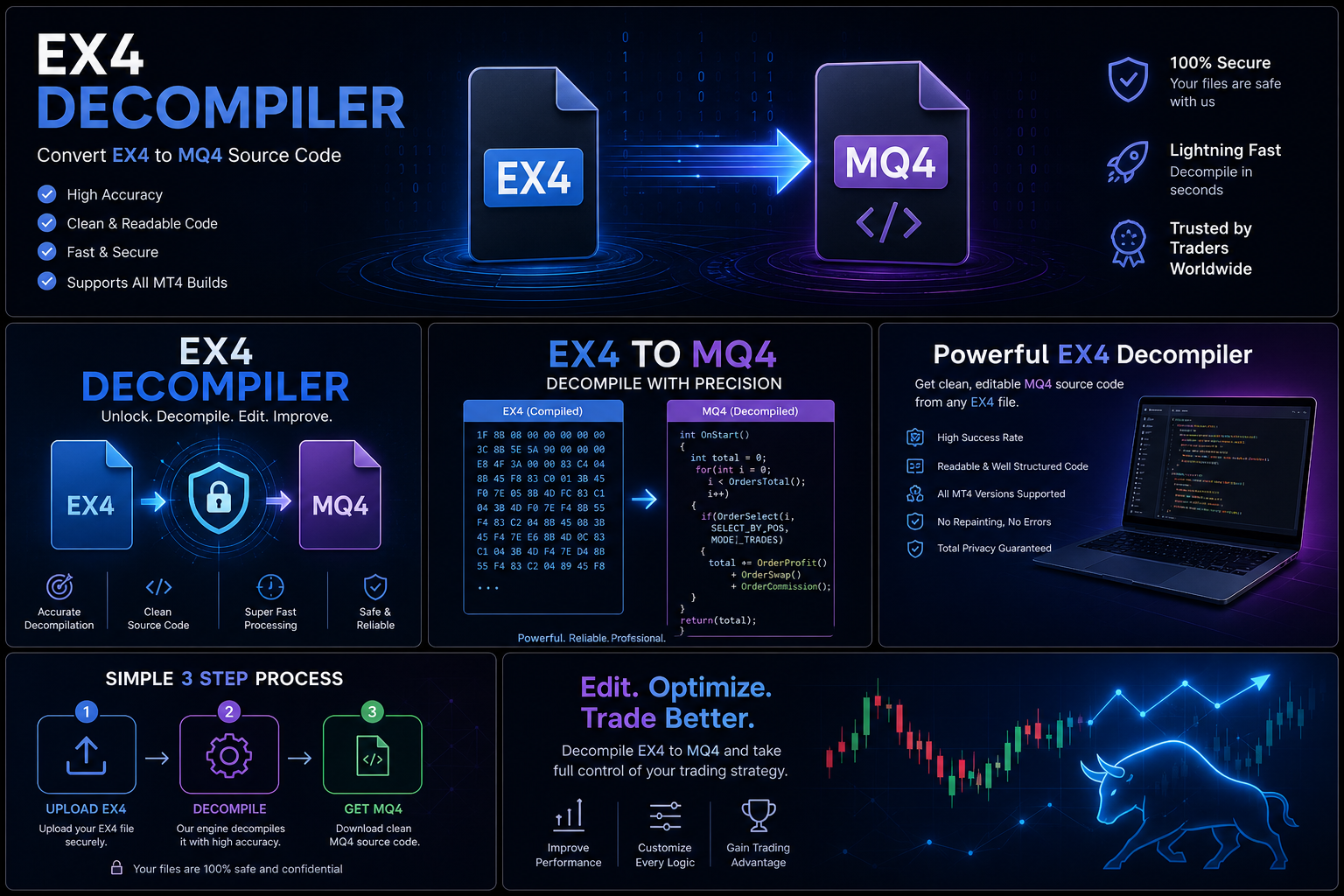

The Complete Guide to EX4 Recovery in 2026: Risks, Legality & How It Really Works
Introduction
If you’ve ever lost the original source code for a MetaTrader 4 Expert Advisor (EA), custom indicator, or script, you know how disruptive it can be. Without the original MQ4 source file, updating trading logic, fixing bugs, or adding new features becomes significantly more difficult.
This guide explains how EX4 files work, why recovering source code is challenging, when recovery may be appropriate, the legal issues to consider, and the practical options available to traders and developers in 2026. Rather than making unrealistic promises, this article focuses on helping you understand the technology and make informed decisions.
What Is an EX4 File?
An EX4 file is the compiled version of an MQ4 source file used by MetaTrader 4. Compilation converts human-readable MQL4 code into a format that the platform can execute efficiently.
Once compiled, the EX4 file is intended to run—not to be edited directly. Information useful during development, such as comments, formatting, and descriptive names, is generally not preserved in the executable output.
What Is an MQ4 File?
An MQ4 file contains the original MQL4 source code. Developers use it to:
- Update trading strategies
- Fix software defects
- Improve performance
- Add features
- Maintain compatibility with newer platform versions
Losing the MQ4 file can make ongoing maintenance much more difficult.
Why Source Code Gets Lost
Common reasons include:
- Accidental deletion
- Hard drive failure
- Lost backups
- Developer retirement
- Company closure
- Corrupted storage devices
- Inadequate version control
These situations highlight the importance of regular backups and secure source-code management.
Why People Seek Source Code Recovery
Legitimate reasons may include:
- Recovering your own lost project.
- Continuing maintenance of software you own.
- Restoring a legacy system after backups were lost.
- Working on software with the author’s permission.
Any recovery effort should respect copyright, licensing terms, and contractual obligations.
How EX4 Files Work (High-Level Overview)
When an MQ4 project is compiled:
- The source code is translated into executable form.
- Development-oriented information is reduced or removed.
- The resulting EX4 file is optimized for execution by MetaTrader.
Because of this transformation, reconstructing the original source exactly is generally not possible.
What Makes Recovery Difficult?
Several factors influence whether meaningful recovery is feasible:
- Compiler changes over time
- Optimizations applied during compilation
- Removed comments and formatting
- Loss of descriptive identifiers
- Modern protection techniques
- File integrity issues
These limitations are why recovery outcomes can vary widely.
Common Myths About EX4 Recovery
Myth 1: Every EX4 file can be restored perfectly
Reality: Compiled executables do not retain all of the information present in the original source code.
Myth 2: Recovery is always quick
Reality: Complexity depends on the project, compiler version, and the condition of the available files.
Myth 3: Modern files are identical to older ones
Reality: Toolchains and platform updates have changed over the years, affecting compatibility and recovery expectations.
Myth 4: Recovery is always legal
Reality: Authorization and copyright matter. You should only recover or modify software you own or have permission to work on.
Legal Considerations
Software is generally protected by copyright and licensing agreements. Before attempting any recovery or modification, ensure that you have the legal right to do so.
Examples of appropriate scenarios include:
- Recovering your own lost source code.
- Working under a contract with the software owner.
- Maintaining software when the author has granted permission.
When in doubt, seek legal advice relevant to your jurisdiction.
Best Practices for Protecting Your Own Projects
Preventing source-code loss is far easier than trying to recover it later. Consider these practices:
- Keep multiple backups.
- Use version control.
- Store backups in more than one physical location.
- Maintain secure cloud copies.
- Document project changes.
- Archive released versions.
These habits reduce the risk of losing valuable development work.
What If Recovery Isn’t Possible?
If the original source cannot be recovered, alternatives may include:
- Rebuilding the project from specifications you own.
- Creating a new implementation based on documented requirements.
- Updating trading workflows around available software.
- Working with the original developer if they are available.
The right option depends on your goals and your rights to the software.
Frequently Asked Questions
Can every EX4 file be converted back into its original MQ4 source?
No. Compilation changes the software in ways that generally prevent perfect reconstruction of the original source.
Will recovered code look exactly like the original?
Not necessarily. Information such as comments, formatting, and descriptive naming is often unavailable after compilation.
Is it legal to recover source code?
It depends on ownership, permissions, copyright, and licensing. Recovery should only be pursued when you have the appropriate rights.
How can I avoid losing my source code?
Use version control, maintain multiple backups, and keep copies in secure, separate locations.
Final Thoughts
Losing an MQ4 source file can be a serious setback, but understanding how EX4 files are created helps explain why recovery is often complex and why results vary. The best long-term strategy is prevention: maintain reliable backups, adopt good development practices, and document your projects thoroughly.
If you are seeking to recover software that you own or are authorized to maintain, begin by gathering any available project materials, backups, or documentation. Even when the original source cannot be reproduced exactly, those resources can significantly simplify rebuilding or maintaining the project while respecting intellectual property rights.